

Munitions Information System – Korea Institute of Defense Analysis
KIDA switched from Oracle to Altibase for its munitions deployment dispatchers, strengthening national defense ability while lowering CPU resources and TCO.
- Use Case
- Munitions Information System
- Current Customer
- KIDA
- Industry
- Public
Who
Problem
Inadequate performance: information on munitions inventories was neither current nor accurate. The resulting communication between soldiers was oftentimes erroneous.
High TCO: the total cost of operating and maintaining the existing system was unmanageable and onerous.
Incompetent technical support: KIDA technicians were stonewalled by Oracle’s technical support. Notwithstanding deployment issues and unfulfilled assurances, KIDA could not elicit straight answers from the support staff for problems with ongoing systemic issues.
Solution
KIDA decided on Altibase over Oracle TimesTen for three primary reasons.[2]
Altibase benchmark test results grossly outperformed those of Oracle TimesTen.
Altibase’s best-in-class technical support
Significantly lower TCO
Results
Superior speed, reliability and stability fortify KIDA’s mission critical responsibilities. With 1,500 simultaneously connected sessions, efficiency is maximized, utilizing 25% less CPU usage.
South Korea’s armed forces are now equipped with accurate munitions information.
KIDA leverages Altibase’s technical support, benefiting from rapid response time and effectual information exchange.
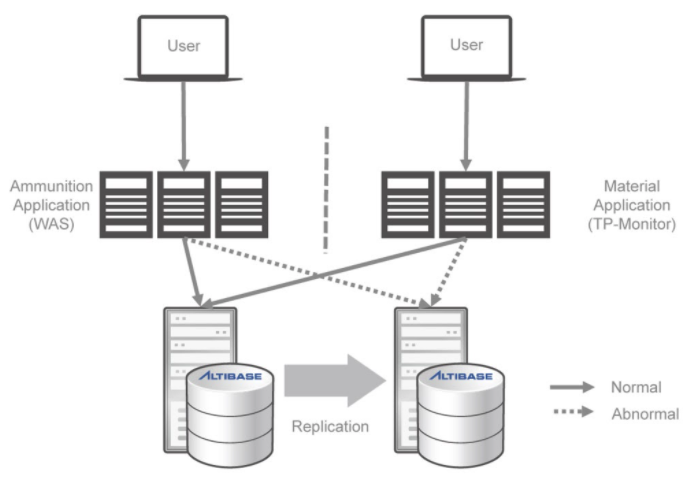
[2] Altibase, with its server configuration, is capable of effortlessly loading 5 years of KIDA’s entire data into memory. As a result, KIDA can process virtually everything it needs in memory with no need to read from or write to disk. The outcome is incomparable performance enhancement